Showing posts with label Nobel Prize. Show all posts

Monday, October 4, 2010

Robert Edwards - Nobel '10

The Nobel Prize in physiology or medicine has been awarded this year to Robert G. Edwards, an English biologist who, with a physician colleague, Patrick Steptoe, developed the in vitro fertilization procedure for treating human infertility.

Since the birth of the first test tube baby, Louise Brown, on July 25, 1978, some four million babies worldwide have been conceived by mixing eggs and sperm outside the body and returning the embryo to the womb to resume development. The procedure overcomes many previously untreatable causes of infertility.

Dr. Edwards, a physiologist who spent much of his career at Cambridge University in England, spent more than 20 years solving a series of problems in getting eggs and sperm to mature and successfully unite outside the body. His colleague, Dr. Steptoe, was a gynecologist and pioneer of laparoscopic surgery, the method used to extract eggs from the prospective mother.

Dr. Steptoe, who presumably would otherwise have shared the prize, died in 1988. Dr. Edwards, who born in 1925, has now retired as head of research from the Bourn Hall Clinic in Cambridge, which he and Dr. Steptoe founded as the world’s first center for in vitro fertilization.

Though in vitro fertilization is now widely accepted, the birth of the first test tube baby was greeted with intense concern that the moral order was subverted by unnatural intervention in the mysterious process of creating a human being. Dr. Edwards was well aware of the ethical issues raised by his research and took the lead in addressing them.

The objections gradually died away, except on the part of the Roman Catholic Church, as it became clear that the babies born by in vitro fertilization were healthy and that their parents were overjoyed to be able to start a family. Long-term follow-ups have confirmed the essential safety of the technique.

The deliberations of the prize-giving committee at the Karolinksa Institute in Sweden are confidential, and it is unclear why it took so long to acknowledge Dr. Edwards’s achievement. The committee routinely ignores the stipulation in Alfred Nobel’s will that the prize should be awarded for a discovery made the preceding year, because it takes longer than that to evaluate most scientific claims, but delays of 30 years or more are unusual. The Lasker Foundation in New York, whose jurors often anticipate the Nobel Prize committee, awarded Dr. Edwards its prize in 2001.

Dr. Edwards’s research proved too controversial for the Medical Research Council, a government financng agency that is the British equivalent of the National Institutes of Health. In 1971 the council rejected an application from Dr. Edwards and Dr. Steptoe to work on in vitro fertilization, but they were able to continue with private funds.

“In retrospect, it is amazing that Edwards not only was able to respond to the continued criticism of in vitro fertilization, but that he also remained so persistent and unperturbed in fulfilling his scientific vision,” Christer Höög, a member of the Nobel Prize committee, writes on the Nobel Foundation’s Web page.

Image: Lesley and Louise Brown with her son Cameron and Professor Robert Edwards

Monday, April 12, 2010

Blood groups

Marcello Malpighi

Malpighi was born in Crevalcore near Bologna in Italy, raised on the farm his parents owned and entered the University of Bologna at the age of 17. Malpighi began to study. When his father, mother and paternal grandmother died, he had to abandon his studies for more than two years to settle family affairs. He returned to university after two years, and became a doctor of medicine in 1653. The next year he married Francesca Massari, younger sister of his anatomy professor. She died a year later.

In 1656 Malpighi received a chair of medical practice in the university, three years after he had applied for it, and later the same year University of Pisa created a chair of theoretical medicine for him. He stayed in Pisa for three years and then returned to Bologna. In 1661 he was called to University of Messina where he stayed for four years.


Most of Malpighi's research results were published as articles in the journal of the Royal Society of England. His first article appeared there in 1661 and was about anatomy of a lung of a frog during which he had discovered capillaries. In 1667 Henry Oldenburg invited Malpighi to correspond with the Royal Society regularly and he became a fellow the next year, the first such recognition given to an Italian.

Malpighi used the microscope for studies on skin, kidney, and for the first interspecies comparison of the liver. He greatly extended the science of embryology. The use of microscopes enabled him to describe the development of the chick in its egg, and discovered that insects (particularly, the silk worm) do not use lungs to breathe, but small holes in their skin called tracheae. Later he falsely concluded that plants had similar tubules. However, he observed that when a ringlike portion of bark was removed on a trunk a swelling of the tissues would occur above the ring. He correctly interpreted this as growth stimulated by food coming down from the leaves, and being blocked above the ring. He was the first to see capillaries and discovered the link between arteries and veins that had eluded William Harvey.

Malpighi is regarded as the founder of microscopic anatomy and the first histologist. Many microscopic anatomical structures are named after him, including a skin layer (Malpighi layer) and two different Malpighian corpuscles in the kidneys and the spleen, as well as the Malpighian tubules in the excretory system of insects.

He also studied chick embryo development with detailed drawings and discovered taste buds of human tongue. Some of his studies he made by vivisection. He also studied the anatomy of a brain and concluded that this organ is a gland. In terms of modern endocrinology this deduction is correct because neurotransmitter substances represent paracrine hormones, and the hypothalamus of the brain has long been recognized for its hormone-secreting capacity. He was also among the first to study human fingerprints.

In 1691 Pope Innocent XII invited him to Rome as Papal physician. He taught medicine in the Papal Medical School and wrote a long treatise about his studies which he donated to the Royal Society of London.

Marcello Malpighi died of apoplexy in Rome on September 30, 1694

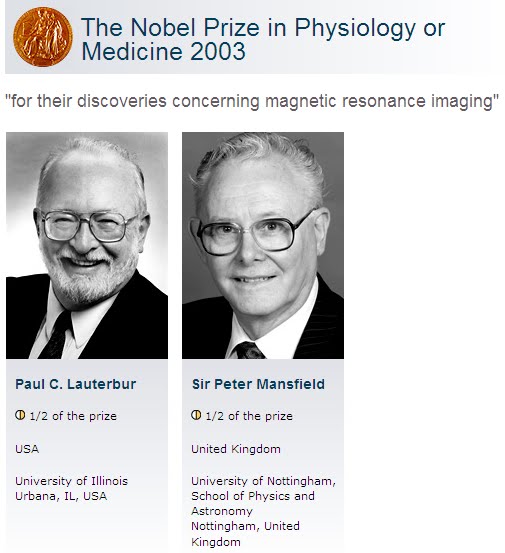
MRI - Nobel Prize

Prions and Prusiner

                                  
The word prion, coined in 1982 by Dr. Stanley B. Prusiner, is a portmanteau derived from the words protein and infectious.

Stanley Ben Prusiner (born May 28, 1942[1]) is an American neurologist and biochemist. Currently the director of the Institute for Neurodegenerative Diseases at University of California, San Francisco (UCSF). Prusiner discovered prions, a class of infectious self-reproducing pathogens primarily or solely composed of protein. He received the Albert Lasker Award for Basic Medical Research in 1994 and the Nobel Prize in Physiology or Medicine in 1997 for his prion research.

Warren and Marshall

Two Australian scientists who upset medical dogma by discovering a bacterium that causes stomach inflammation, ulcers and cancer won the 2005 Nobel Prize for Physiology or Medicine. The findings by the Australians in the early 1980's went so against medical thinking, which held that psychological stress caused stomach and duodenal ulcers, that it took many more years for an entrenched medical profession to accept it.

In the early 1980's, Dr. Warren noted the bacterium in the lower part of the stomach in about half of the patients who had biopsies. He made a crucial observation that signs of inflammation were always present in the surface lining of the stomach near where he observed the bacterium.


Dr. Marshall joined Dr. Warren in studying biopsies from a series of patients. After several attempts, Dr. Marshall succeeded in growing a bacterium that was unknown then; he named it Campylobacter pyloridis, believing that it was a member of the Campylobacter family. (It was later found to be a member of the Helicobacter family and renamed H. pylori.)

Still, many doctors were unconvinced by the findings, a point recognized by the Nobel committee, which said the award went to Dr. Marshall and Dr. Warren "who with tenacity and a prepared mind challenged prevailing dogmas."

Dr. Marshall carried on a medical tradition in experimenting on himself to test his and Dr. Warren's theory and to show that Helicobacter was the primary cause of gastritis, not a secondary invader.

In earlier interviews, Dr. Marshall described how at age 32, he swallowed a gastroscope tube to allow another doctor to look at his stomach and take several biopsies. These procedures and examinations were needed to document that Dr. Marshall had no H. pylori in his stomach and did not suffer from gastritis or another abnormality.

Dr. Marshall waited 10 days for the areas that had been biopsied to heal and then swallowed a pure culture of H. pylori. A week later, he had an unusual sensation of fullness after eating supper and felt ill. Friends told him that his breath was "putrid."

Ten days after the onset of symptoms, Dr. Marshall underwent the first of an additional three gastroscopies. Biopsies obtained through them showed that he had developed gastritis or inflammation of the stomach, but he did not continue the experiment long enough to develop an ulcer. His symptoms quickly disappeared after treatment.
Source:http://www.nytimes.com/2005/10/04/science/04nobe.html?pagewanted=2

The First Nobel in Medicine

Behring was the discoverer of diphtheria antitoxin and attained a great reputation by that means and by his contributions to the study of immunity. He won the first Nobel Prize in Physiology or Medicine in 1901 for developing a serum therapy against diphtheria (this was worked on with Emile Roux) and tetanus.

Discovery of Vitamin B12

B12 deficiency is the cause of pernicious anemia, an anemic disease that was usually fatal and has unknown etiology when it was first described in medicine. The cure, and B12, were discovered by accident. George Whipple had been doing experiments in which he induced anemia in dogs by bleeding them, and then fed them various foods to observe which diets allowed them fastest recovery from the anemia produced. In the process, he discovered that ingesting large amounts of liver seemed to most-rapidly cure the anemia of blood loss. Thus, he hypothesized that liver ingestion might treat pernicious anemia. He tried this and reported some signs of success in 1920.


After a series of careful clinical studies, George Richards Minot and William Murphy set out to partly isolate the substance in liver which cured anemia in dogs, and found that it was iron. They also found that an entirely different liver substance cured pernicious anemia in humans, that had no effect on dogs under the conditions used. The specific factor treatment for pernicious anemia, found in liver juice, had been found by this coincidence. Minot and Murphy reported these experiments in 1926. This was the first real progress with this disease. Despite this discovery, for several years patients were still required to eat large amounts of raw liver or to drink considerable amounts of liver juice.

In 1928, the chemist Edwin Cohn prepared a liver extract that was 50 to 100 times more potent than the natural liver products. The extract was the first workable treatment for the disease. For their initial work in pointing the way to a working treatment, Whipple, Minot, and Murphy shared the 1934 Nobel Prize in Physiology or Medicine.

These events in turn eventually let to discovery of the soluble vitamin, called vitamin B12, in the liver juice. The vitamin in liver extracts was not isolated until 1948 by the chemists Karl A. Folkers of the United States and Alexander R. Todd of Great Britain. The substance proved to be cobalamin—the most complex of all the vitamins. It could also be injected directly into muscle, making it possible to treat pernicious anemia more easily

Dorothy Hodgkin completed the elucidation of B12's chemical structure by using x-ray crystallography, receiving the 1964 Nobel Prize in chemistry for her work. Vitamin B12 was finally synthesized by Robert Burns Woodward in 1971, after a ten year effort.